
The Guardian’s “Southern Frontlines”: When Activism Masquerades as Reporting
As we have been documenting in recent months, a network of wealthy, U.S.-based foundations has been orchestrating a campaign to undermine our industry. These attacks often rely on irresponsible, distorted journalism that is, in some cases, arranged financially and logistically by deep-pocketed activists, not truth-seeking journalists.
Among the news organizations taking these kinds of unethical payments from the foundation network, few if any get more money than the UK's Guardian, which is bankrolled by a wide array of ideologically-driven groups that are explicitly hostile to salmon aquaculture.
Naturally, the articles that result from these cash payments align with the opinions and political agendas of the foundation donors, and that's exactly what has happened in the latest article about Chilean salmon farming in The Guardian, was published on December 2, 2025.
The article contains a range of factual errors, willful distortions, critical omissions, and is so outrageously hyperbolic in its rhetoric that the headline insinuates eating farmed Chilean salmon is like consuming human blood.
Manufacturing Safety Concerns
The article is keyed on a seemingly fabricated claim about deaths from workplace accidents between 2013 and 2025. Hard data from DIRECTEMAR (Chile's maritime authority) shows the Guardian inflated the real number of incidents by a factor of more than three.
Those figures are carefully monitored because safety is the highest priority in our industry, a commitment that is reflected in the continuous advances in safety practices that are occurring each year. In 2024, the industry achieved a historic milestone: zero diving fatalities.
That accomplishment is in part a result of initiatives like the “Auditable Diving Standard,” instituted in 2021 in close collaboration with the sector's Multi-Union Federation, the National Divers’ Union, and Coordinadora de Trabajadores de la industria del salmón (Workers' Coordination).
We have also significantly strengthened safety infrastructure by expanding the hyperbaric chamber network in operating zones, creating standardized usage protocols, and professionalizing the diving activity through partnerships with specialized schools, training over 100 workers in various specializations.
We would have gladly detailed all this to The Guardian, but we were never contacted — neither by the reporter nor Guardian editors.
The Antibiotics Distortion
The article leans heavily on supposed "antibiotic overuse" and "rampant antibiotic use" -- but this is factually false in several key respects.
Chilean farmed salmon is raised under strict legal oversight and antibiotics are prescribed only by independent veterinarians, based on their expert judgment. Mandatory FDA residue testing ensures every fillet that is exported is antibiotic-free. Yet the Guardian attempts to mislead readers by claiming that confirmed antibiotic-free product could still "lead to antimicrobial resistance" or "promote the transfer of antibiotic-resistant bacteria to humans."
Consumer safety remains rigorously protected: every harvest batch undergoes mandatory withdrawal periods and testing by Sernapesca, Chile’s national fisheries and aquaculture service, to guarantee zero antibiotic residues before export. The U.S. FDA routinely validates these standards, confirming that any Chilean salmon reaching American shelves meets strict safety requirements.
Microbes are a challenge for all food production and, contrary to what the Guardian implies, Chile’s salmon sector isn’t unique in that respect. But our rigorous tracking, vet-only prescriptions, and zero-tolerance export rules make it among the safest. The industry has slashed antibiotic use through vaccines, biosecurity, and probiotics.
Just last year, we launched the Yelcho Project, a public–private partnership between SalmonChile, Sernapesca, SAG, and 11 producing companies (representing 90% of national output) to accelerate the development of vaccines and innovative immunological solutions.
We would have gladly gone on the record with facts like these but, again, the Guardian never reached out to us.
Environmental Impact and Community Relations
The article's claims of “severe environmental damage,” widespread pollution from chemicals and antibiotics, ruined ecosystems, and harm to Indigenous communities are flatly contradicted by the facts on the ground.
In reality Chilean salmon farming is one of the country’s most rigorously monitored industries. The Guardian article relies on one labor inspector quoted about his equipment — yet in 2024, the Environmental Superintendency carried out 1,819 inspections, recording a 99.8 % compliance rate.
SalmonChile has cleaned over 8,000 km of shoreline with local fishers and communities, removing 35,578 m³ of waste — far beyond our own footprint. In 2023, 100% of our harvest was certified to global sustainability standards. We’ve signed Clean Production Agreements and are measuring carbon and water footprints. Those are responsible practices and real results — measured and closely overseen by regulators.
The article again suggests weak oversight by citing one labor inspector complaining about resources for remote sites.
But in reality, Chilean salmon farming operates under some of the strictest rules worldwide, including the LGPA, RESA, RAMA, and a robust biosafety system enforced by SMA, Sernapesca, and Subpesca. Production is halted or curtailed the moment health thresholds are breached. Every shipment to over 100 global markets passes exhaustive chemical and microbiological tests.
That's why SalmonChile helped draft and pass Law 21.532 (2023), imposing heavy fines and suspensions for escapes — a standard that resulted in a sharp drop in incidents. We’re also providing expertise for new diving-safety legislation now before Chile's Senate.
The narrow geographic footprint of our industry is also obscured in the article. Rather than being a major feature on the Chilean coastline, the industry uses just 4,200 hectares—0.002% of Chile’s territorial sea. In short: It is highly regulated, tightly controlled, and demonstrably safe -- facts that were all concealed from readers.
Transparency
All these facts and more are openly available because we are fully committed to transparency. For over ten years we’ve voluntarily published a detailed Sustainability Report: with production volumes, antibiotic use, escapes, health data and more openly available on our website. We see the blue economy as the future: aquaculture that works with communities, protects the environment, and delivers real prosperity to southern Chile. Sustainability is now baked into every decision. Challenges remain, but we tackle them head-on with science, long-term olanning, and genuine collaboration. Economic growth, healthy oceans, and thriving local people aren’t mutually excluscid — they are our goal every day.
Erasure of the Human Economy
The Guardian’s most glaring omission was its erasure of the Chilean workforce. It treats the salmon sector as an abstract corporate entity, ignoring its role as the economic engine of southern Chile. This industry is Chile’s second-largest export, generating nearly $5 billion annually and sustaining 60,000 to 86,000 jobs across La Araucanía, Los Lagos, Aysén, and Magallanes.
Research shows a clear link between salmon operations and significant poverty reduction in these remote regions. Yet by amplifying foreign-funded NGOs over the voices of thousands of local and indigenous workers, The Guardian is engaging in a kind of “Green Imperialism” — elevating wealthy foreign activists as arbiters while sidelining the communities that actually live and work there.
In a recent exposé, Juan Carlos Tonko Paterito of the Kawésqar Indigenous Community in Puerto Edén, described foundations like the Guardian's donors this way:
“We have seen how imperialists show their tentacles in our territories. Now its form is more surreptitious and typical of our time. It is no longer about putting the boot on top, but about meddling in the communities, creating some [indigenous people] on demand, acclimatizing them and, then, beating the cloths through social networks and … media to legitimize them as the only and authentic [indigenous people] because they are friends of the settler. … The new Yanaconas are now digital and globalized by the hand of the green colonialists … It cannot be that we are at the mercy of organizations of which we know little or nothing about their interests and for which Chilean citizens have not voted to govern our destinies as they are doing … Today we demand that the Government of Chile set its territorial policy in Magallanes, not that it be dictated by these organizations and their local allies.”
The bottom line is that Chile’s salmon-farming community is open to dialogue. We publish data, open our doors to inspectors, and acknowledge challenges when they arise. What we won't accept is the interference of foreign activists who treat our livelihoods as expendable details to boost their fundraising cycles.
The Context: Journalism or Advocacy?
It is essential to understand the funding structure that incentivized this publication. The Guardian’s coverage of Chilean salmon is bankrolled by a network of wealthy American and European foundations with a sharp ideological antipathy toward our industry.
The reporting was financed by JournalismFund Europe and the Open Society Foundations (OSF). The OSF, created by Wall Street financier George Soros and operated by his son, Alex, is among the very largest donors to partisan anti-industry advocacy in the world.
While The Guardian briefly acknowledged support from these two donors, it didn't mention that the Soros-backed OSF has contributed approximately $1 million to JournalismFund Europe since 2016 alone. As of 2024, the group also lists the Arcadia and Adessium Foundations as two of its largest donors; together they've given the Fund nearly $3 million. Both foundations have a long history of supporting anti-aquaculture activism in Chile, including funding the Earth Journalism Network — another nonprofit journalism outfit that orchestrated an equally fallacious 2024 New York Times attack on our industry.
The Guardian's development section, where this story appeared, was launched in 2010 with seed money from the Gates Foundation. This is a notable detail because support for The Guardian's development coverage is passed through the US-based nonprofit TheGuardian.org. The organization's 2024-25 impact report lists several of the same anti-aquaculture donors as its biggest supporters. This includes the Packard, Arcadia, and Oak Foundations, all of which have played important roles in financing and orchestrating international campaigns against salmon farming, particularly in Chile. Like Packard, Arcadia and Oak are also supporters of Earth Journalism Network.
In short, the same wealthy donors that finance anti-salmon activism in Chile bankroll favorable media coverage for that activism in foreign news outlets. Activists generate the talking points, foundations fund the media initiative, and the media cites those activists to “confirm” the narrative — a circular feedback loop.
Let's be clear: this is earmarked funding from foundations with an active political agenda to drive hostility toward our industry.
Coordinated PR Tactics
At the same time that the Guardian reporting was happening, a separate article appeared in the prestigious New York Review of Books -- also attacking salmon farming in Chile. Using some of the same sources, a similar framing, and also focusing in part on labor issues, the article was written by a professor at a Norwegian university, Ernesto Semán. But this too was financially rigged. Semán, a longtime left-leaning commentator from Argentina, heads a project at University of Bergen called DARKLAX that is specifically aimed at disparaging salmon farming in Chile, what he calls "the dark side of sustainability." Among many other outlandish claims in his article, Semán says that salmon farming in Chile "amounts to torture" because salmon "can recognize themselves in a mirror, just as humans do." Just last year, Semán received more than 12 million NOK (about $1.1 million USD) from the Research Council of Norway (RCN) to bankroll that effort. RCN is a Norwegian government agency, overseen by that country's Ministry of Trade, Industry, and Fisheries. And just like the Guardian article, the Semán piece relies heavily on an activist group called Ecoceanos, which in recent months has ramped up its focus on labor issues. Although Ecoceanos conceals most of its funding sources, it is apparent they too are bankrolled in part by wealthy American foundations like Marisla Foundation.
Pre-arranged Narratives
Here are the grant requirements from JournalismFund — in which writers compete for a €10,000 award to target the Chilean Salmon industry. To win the money, journalists must present "a hypothesis" for their story before doing any reporting — in other words, imagine the outcome in advance and have that framing approved by the donors. In addition, the JournalismFund says it can "cover costs related to ... a range of expenses, including logistics, insurance, legal support, as well as access to technology and data sets."
In this method, donors and activist groups are not simply pitching stories to independent news outlets; they have vertically integrated the entire process. They hand-pick the writers, give them cash, set strict requirements, arrange their travel and all the reporting logistics, and then carefully measure the result.
This is simply not legitimate or independent journalism — it is highly orchestrated and completely at odds with widely accepted journalism ethics standards.
We intend to expose this sort of misconduct in any coverage of our industry and set the record straight.
Additional Funding
List of foundations that are bankrolling The Guardian (circa 2023) can be found here.
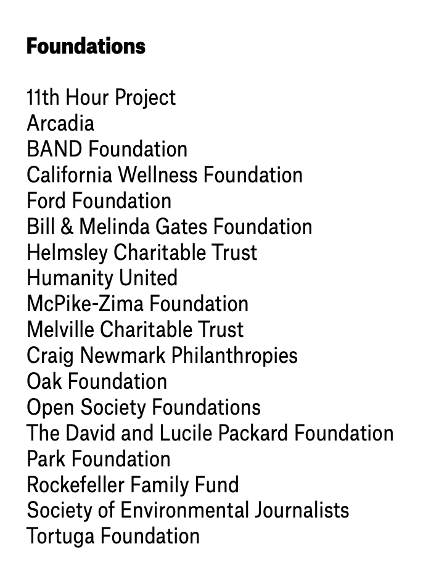
David & Lucile Packard Foundation
2024 - $900,000, "to renew support for Seascape, an environmental reporting series focused on illegal, unreported, and unregulated fishing and the connection between ocean conservation and climate change"
2022 - $600,000, "to renew support for Seascape, an environmental reporting series focused on illegal, unreported, and unregulated fishing and the connection between ocean conservation and climate change"
2021 - $600,000, "to renew support for Seascape, an environmental reporting series focused on illegal, unreported, and unregulated fishing and the connection between ocean conservation and climate change"
Bill and Melinda Gates Foundation
2023 - $3,600,000, "Global Health and Development Public Awareness and Analysis"
2020 - $3,499,032, "Global Health and Development Public Awareness and Analysis"
Park Foundation
2023 - $300,000, "General operating support for theguardian.org"
2022 - $150,000, "General operating support for theguardian.org"
2021 - $200,000, "General operating support"
2020 - $150,000, "Media"
Oak Foundation
2023 - $600,000, "To provide core support to theguardian.org to fund the Age of Extinction reporting project."
Rockefeller Family Fund
2022 - $150,000, "Project support - environment"
2021 - $300,000, "Project/General support - environment"
Society of Environmental Journalists
2022 - $100,000, "Coverage project"
2021 - $100,000, "Coverage project"
2020 - $120,000, "Coverage project"
Schmidt Family Foundation (11th Hour Project)
2023 - $500,000, "Working towards a resilient and equitable food system"
2022 - $500,000, "Working towards a resilient and equitable food system"
2021 - $500,000, "Working towards civic engagement"
2020 - $500,000, "Working towards civic engagement"
BAND Foundation
2023 - $300,000, "Age of Extinction"
2022 - $300,000, "Age of Extinction"
2021 - $300,000, "Age of Extinction"
2020 - $300,000, "Age of Extinction"
Humanity United
2023 - $210,000, "Journalism"
2022 - $640,000, "General operating support"
2020 - $1,500,000, "Investigative Journalism"
McPike-Zima Foundation
2023 - $75,000, "To help support journalism"
2021 - $50,000, "To help support journalism"
Tortuga Foundation
2024 - $50,000, "Charitable"
2023 - $75,000, "General Charitable Purposes"
2022 - $50,000, "General Charitable Purposes"
2021 - $50,000, "General Charitable Purposes"